Red-footed Tortoise
Chelonoidis carbonarius
Red-scaled tropical tortoise with an easygoing natureIntermediate
- Lifespan
- 50+ years
- Size
- 12-16 in30-40 cm; cherry-heads average ~10 in25 cm and rarely exceed 12 in30 cm
- Social needs
- More group-tolerant than most tortoises; house males apart
- Time
- Medium-high; feeding daily for juveniles and every other day for adults, daily misting, decades
- Cost
- High
- Diet
- Omnivore (greens, fruit, occasional protein)
Overview
What is this animal?
- The red-footed tortoise is a mid-sized South American species from savannas and forest edges, instantly recognisable by the red-to-orange scales on its dark legs and head.
- Most adults reach 12-16 inches30-40 cm, with large individuals pushing beyond that, while the popular cherry-head form stays noticeably smaller (averaging around 10 in25 cm) and brighter, so this is a substantially bigger animal than the Mediterranean tortoises it is often sold alongside.
- Its care runs opposite to a Russian or Hermann's tortoise in almost every way that matters.
Show 4 more
- It needs tropical warmth and 70-80% humidity year-round, it eats fruit as a normal part of its diet, and it never brumates.
- Keepers who apply dry Testudo-style care to a red-foot produce cracked skin, pyramided shells and respiratory disease.
- With lifespans commonly passing 50 years and enclosure needs that outgrow most spare rooms, this is a serious long-term commitment rather than a starter reptile.
- It rewards that commitment with one of the calmest, most personable temperaments in the tortoise world.
Temperament
- Red-footed tortoises are widely considered the most laid-back and personable of the commonly kept tortoises.
- They are curious, strongly food-motivated, quick to learn a feeding routine, and many will walk over to investigate their keeper rather than retreat.
Show 4 more
- They are also unusually tolerant of company for a tortoise, and well-fed groups of females or mixed pairs can sometimes share a large enclosure without the constant ramming typical of Testudo species.
- That tolerance has limits: males may still spar and harass females, every added animal multiplies the space requirement, and a single tortoise is a perfectly content and simpler default.
- Like all tortoises, they tolerate brief, gentle handling but do not enjoy being carried, and their size and strength make them surprisingly capable of bulldozing flimsy barriers.
- Expect an engaging floor-dwelling companion to observe and hand-feed, not a pet to pick up.
A good fit for
- Keepers ready to manage tropical heat and humidity
- Homes that can dedicate 10.5 x 5.25 ft3.2 x 1.6 m of floor space
- People wanting a calm, food-motivated, interactive tortoise
- Owners prepared for a 50+ year commitment
- Keepers in warm, humid climates with outdoor space
Common mistakes to avoid
- Dry Testudo-style care causing pyramiding and skin damage
- Open tortoise tables that cannot hold 70-80% humidity
- Any attempt to brumate this non-brumating species
- Withholding fruit, or overfeeding fruit and protein
- Night temperatures dropping below 70°F21°C
- Undersized enclosures an adult rapidly outgrows
Enclosure
Minimum 55 sq ft5.12 m² of floor · 10.5 x 5 ft3.2 x 1.6 m
Fine alone or with company. More group-tolerant than most tortoises, but company is not a requirement. House males apart.
- One full-size adult needs a floor of at least 10.5 x 5.25 ft3.2 x 1.6 m, which is eight times by four times the length of a 16-inch40 cm adult; a standard 47 x 24 in120 x 60 cm shop tortoise table is far too small.
- Cherry-heads stay smaller, at about 10 in25 cm, but size the enclosure for the adult the parents reached, not for the hatchling.
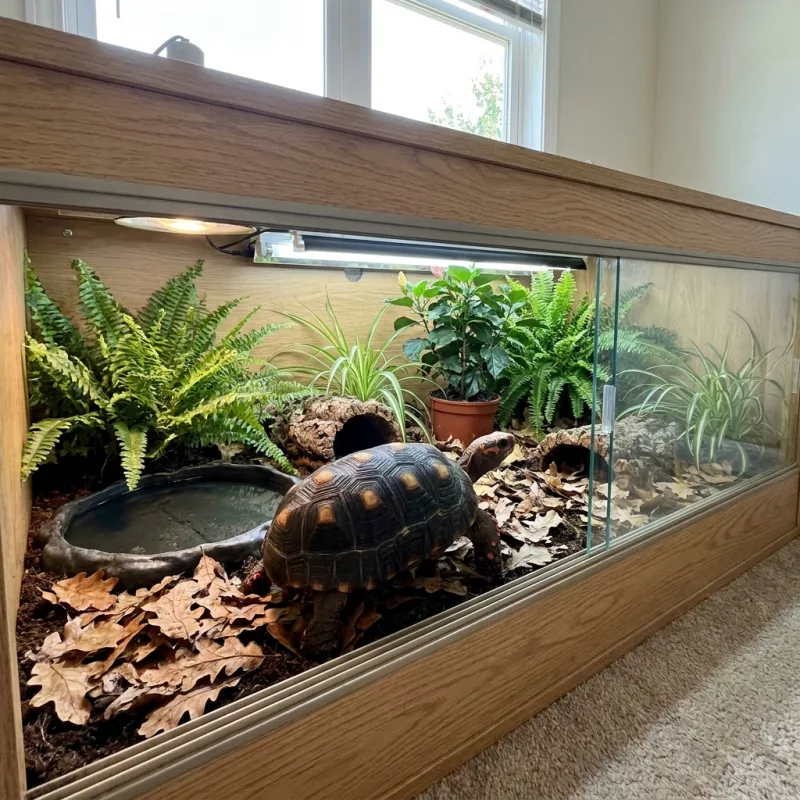
- Indoors that usually means a purpose-built closed chamber or converted room zone, because open tables cannot hold the humidity this species requires.
Show 4 more
- Keep ambient temperatures at 79-86°F26-30°C with a basking spot of 90-95°F32-35°C, and never let nights fall below about 70°F21°C.
- Maintain 70-80% humidity with a deep moisture-holding substrate such as coco coir and cypress mulch, daily misting or an automated fogger, and a shallow water pan large enough for the tortoise to soak its whole body.
- Provide UVB over the basking area and replace bulbs on the manufacturer's schedule, along with shaded hides and plant cover, since this is a forest-edge species that dislikes wide-open glare.
- A planted, predator-proof outdoor pen is the best home whenever the weather is genuinely warm and humid, but in most climates it is a summer-only option with heated shelter on standby.
Supplies
Setup
- Closed, ventilated tropical enclosure, 10.5 x 5.25 ft3.2 x 1.6 m or larger
- Secure outdoor pen
- Heating, UVB and thermostat
- Humidifier, fogger or misting system
- Moisture-holding substrate, leaf litter and furnishings
Ongoing
- Tortoise weed seed mix to grow your own forage
- Dandelion, endive, escarole and chicory from the produce aisle
- Grass hay for grazing species
- Calcium powder for dusting
- Cuttlebone
Show 3 more
- Edible flower mix (dried hibiscus, dandelion blooms)
- Shallow water dish and a soaking tub
- Flat feeding slate or tile to keep food off the substrate
Safe substrate: Topsoil and coco fibre mix, at least 4 in10 cm deep · Cypress mulch or orchid bark mixed in or over soil · Leaf litter on top
Care routine
Daily
- Check temperatures and humidity for the species you keep
- Fresh water bowl
- Look the animal over
- Outdoor time whenever the weather allows
- Spot-clean waste and uneaten food
Every few days
- Greens and weeds, plus fruit (about a quarter to a third of the plate); juveniles daily, adults every other dayevery 2 days
Weekly
- Warm shallow soak
Show 7 more
Every few weeks
- Brief, infrequent handling onlyevery 2 weeks
Monthly
- Check beak and nails
- Deep-clean decor, glass and bowls
- Test thermostats, lamps and guards
- Weigh and record
Less often
- Refresh the substrateevery 3 months
- Check the UVB lamp's age and replace it if due (if one is fitted)every 6 months
Vet: Annual exam and faecal check, every 12 months
Tools
Care in depth
Diet
Omnivore (greens, fruit, occasional protein)
- Red-footed tortoises are omnivores, which separates them sharply from the strictly herbivorous Testudo species.
- Build the bulk of the diet from dark leafy greens, weeds and edible flowers such as dandelion, plantain, endive, escarole and hibiscus.
- Unlike Mediterranean tortoises, fruit is a legitimate part of the menu, reflecting a wild diet rich in fallen forest fruit; offer papaya, mango, banana or berries as roughly a quarter to a third of the food.
- Add a small portion of animal protein once every week or two, such as an earthworm, a little cooked egg or a pinkie-sized portion of moistened low-fat pellet, and no more, because excess protein damages the kidneys and deforms the shell.
- Dust food with calcium regularly, use a calcium-with-D3 supplement for animals without natural sunlight, and keep fresh water available at all times.
- The two classic feeding mistakes are denying fruit entirely as if it were a Hermann's, and overdoing fruit and protein until the tortoise becomes obese with pyramided growth.
Health
Signs of good health, and the common problems
- The most common health failures in red-foots trace back to keeping them too dry or too cold.
- Chronic low humidity causes heavily pyramided shells, flaky skin and slow growth, while cold or damp-and-cold conditions bring on runny noses, wheezing and serious respiratory infections.
- This species does not brumate, ever; a red-foot that goes still and stops eating in winter is sick or too cold, not hibernating, and cooling one down deliberately can kill it.
- Other problems to watch for include metabolic bone disease from poor UVB and calcium, bladder stones from dehydration, parasites in wild-caught animals, and shell rot from constantly wet, filthy substrate.
- A healthy red-foot has bright eyes, clear nostrils, smooth firm shell growth and a steady appetite.
- Establish a relationship with an exotics vet early, get faecal checks on any new animal, and weigh the tortoise monthly so slow declines are caught before they become emergencies.
Is this urgent?
4 warning signs and how fast to act, 1 of them right away
Tortoise problems build over months, so the signs to watch are shape and habit rather than sudden events.
Go now
Today
Soon
This is general guidance for a healthy adult, not a diagnosis. An exotics vet who knows your animal always overrides it, and the time to find one is before you need one.
Bedding and substrate
3 safe, 1 with a caveat, 3 to avoid
A red-foot is a forest tortoise: the substrate has to hold 70-80% humidity without the surface turning into mud.
Safe
With a caveat
Never
The red-foot guide holds 70-80% humidity with daily misting or a fogger; a deep, moisture-holding substrate is what makes that possible.
Top resources for more info
Independent creators and organisations we would send a friend to. We have no affiliation with any of them, and nothing here is sponsored. Links checked 2026-10-22.
YouTubers
Sites
Tortoises, side by side
Same axes, same care guides: the honest way to choose between types.